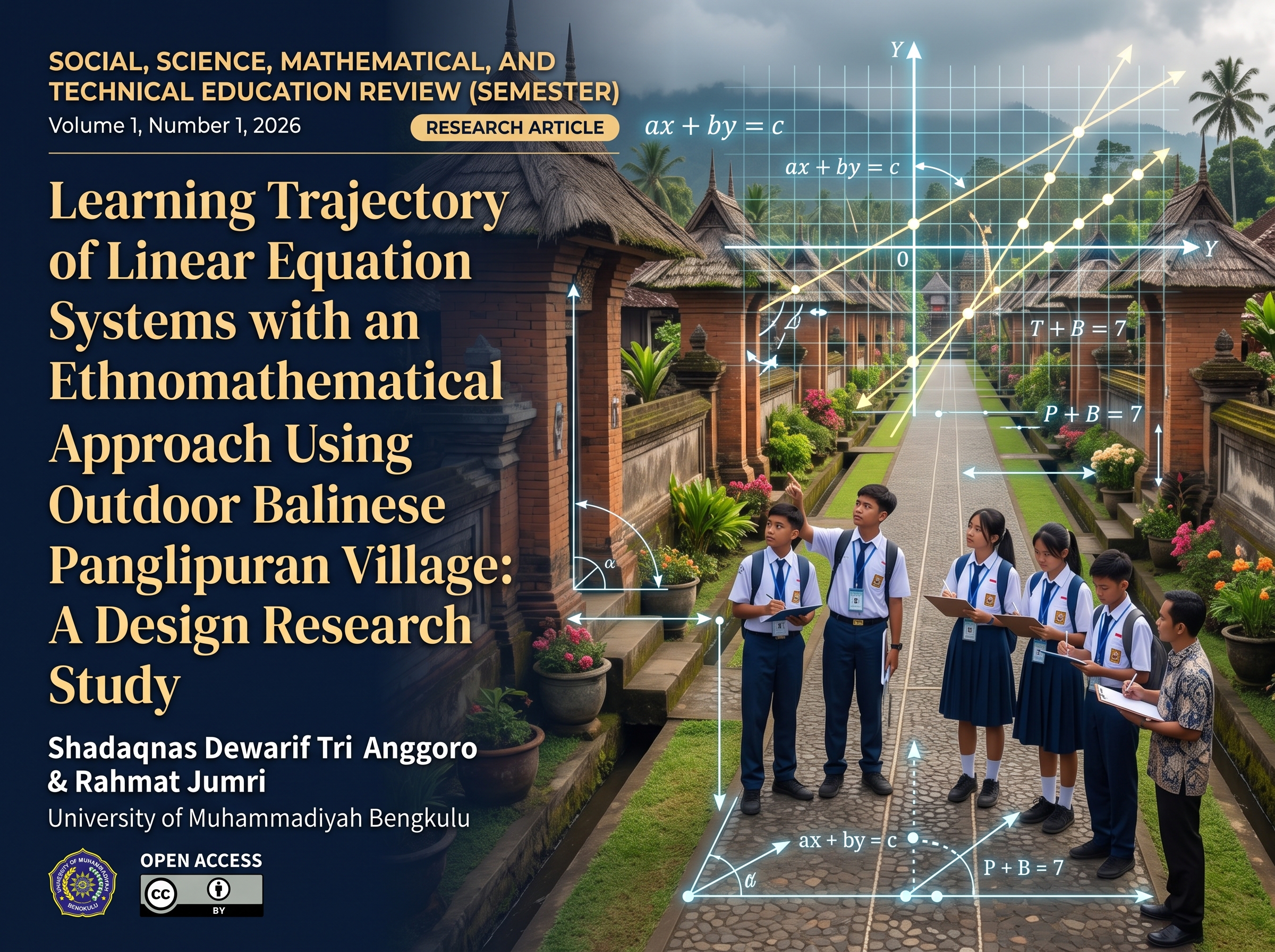
Learning Trajectory of Linear Equation Systems with an Ethnomathematical Approach Using Outdoor Balinese Panglipuran Village: A Design ResearchStudy
DOI:
https://doi.org/10.68964/9k8axg58Keywords:
Linear Equation System, Ethnomathematics, Learning Trajectory, Panglipuran Village, Design ResearchAbstract
Mathematics learning, particularly Linear Equation Systems (SPLs), often presents significant challenges for students in different parts of the world, characterized by difficulties in problem modeling, conceptual understanding, and mastery of solving procedures. The nature of SPL that tends to be abstract is often independent of the real experience of students. Addressing this gap requires an innovative and culturally relevant pedagogical approach. This study explores the development and potential effectiveness of a Hypothetical Learning Trajectory (HLT) for SPL integrated with an ethnomathematical approach, utilizing the rich outdoor context of Panglipuran Traditional Village in Bali. Panglipuran Village, with its preserved traditional architecture, unique spatial layout, and socio-cultural activities of its people, is believed to hold various mathematical ideas that can be the starting point for learning. Using the design research framework, this study involves an in-depth analysis of the concept of SPL and the potential of ethnomathematics in Panglipuran, the design of HLT, and a limited teaching experiment to investigate how the HLT facilitates the development of students' understanding. Data was collected through observations, student work results, and interviews during the trial. The proposed HLT guides students through the stages of exploration of mathematical situations in the context of villages, informal and symbolic representations, formalization into SPL models, development of solution strategies, and applications. The findings of the retrospective analysis show that the ethnomathematical context of Panglipuran Village, through designed outdoor activities, successfully provides a concrete experience that facilitates students' transition from informal understanding to formal understanding of SPL. The HLT developed appears to be effective in guiding the development of students' understanding, although challenges remain at the modeling and formalization stages. This study contributes to the literature on ethnomathematics-based learning trajectories and provides practical insights into the use of local cultural heritage as a globally relevant source of mathematics learning
Downloads
References
Adam, S., Masingila, J. O., & Kasenge, D. (2020). Exploring the link between ethnomathematics and academic mathematics in Ugandan primary schools. International Journal of Mathematics Education in Science and Technology, 51(4), 551-566.
Bakker, A. (2018). Design research in education: A practical guide for early career researchers.
Routledge.
Brown, L., Davies, S., & Evans, P. (2023). Cultural heritage and community resilience: A case study of Desa Panglipuran, Bali. Journal of Cultural Studies, 9(1), 45-60.
Chen, L., Wang, Y., & Zhang, Q. (2021). Analyzing common difficulties of middle school students in solving systems of linear equations. International Journal of STEM Education, 8(1), 1-15.
Clements, D. H., & Sarama, J. (2004). Learning trajectories in early mathematics: Sequences of acquisition and teaching. Early Childhood Education Journal, 31(2), 81-87.
Clements, D. H., & Sarama, J. (2007). Effects of learning trajectories in an early childhood mathematics curriculum on children's achievement. Journal for Research in Mathematics Education, 38(2), 136-160.
Cobb, P., Confrey, J., diSessa, A., Lehrer, R., & Schauble, L. (2003). Design experiments in educational research. Educational Researcher, 32(1), 9-13.1
Confrey, J., & Maloney, A. P. (2015). A framework for learning trajectories: Lessons from research and practice. ZDM Mathematics Education, 47(4), 507-523.
Daro, P., Mosher, F., & Corcoran, T. (2011). Learning trajectories in mathematics: A foundation for standards-based and research-based professional development. CPRE Research Reports RR-
68. Consortium for Policy Research in Education.
Davis, M., & Miller, S. (2023). From words to symbols: Investigating students' challenges in modeling word problems with linear equations. Journal of Mathematical Behavior, 71, 101065.
Fadlelmula, F. K. (2020). The effect of using Learning Trajectory on students' understanding of fraction concept. International Journal of Learning and Teaching, 6(1), 16-21.
Fancsali, S. (2020). The impact of ethnomathematics on students' attitudes towards mathematics: A meta-analysis. Journal of Ethnomathematics and its Applications, 1(1), 45-62.
Green, K., & Lee, B. (2023). Mathematical concepts in Balinese traditional architecture: An exploratory study. Journal of Cultural Mathematics, 5(2), 112-130.
Johnson, R., & Lee, C. (2022). The role of outdoor learning environments in promoting mathematical engagement and understanding. Environmental Education Research, 28(3), 420-435.
López-Bonilla, J. M., & López-Bonilla, L. M. (2020). Mathematical modelling with systems of linear equations: A focus on problem-solving strategies. International Journal of Mathematical Education in Science and Technology, 51(8), 1243-1258.
Murniasih, E., Kholid, M. N., & Maharani, A. (2022). Ethnomathematics exploration: Mathematical concepts in Indonesian traditional crafts. Journal on Mathematics Education, 13(2), 289-304.
Nguyen, T. T. H., & Tran, L. V. (2021). Teaching linear equations: Comparing the effectiveness of abstract vs. contextualized approaches. Eurasia Journal of Mathematics, Science and Technology Education, 17(5), em1958.
Oktaviani, R., & Wahyudin, W. (2022). Analysis of students' conceptual understanding on systems of linear equations in two variables. International Journal of Education and Teaching Learning, 3(1), 1-8.
Organization for Economic Co-operation and Development [OECD]. (2018). PISA 2018 assessment and analytical framework. OECD Publishing.
Prediger, S., Gravemeijer, K., & Confrey, J. (2015). Design research with a focus on learning trajectories. ZDM Mathematics Education, 47(4), 505-518.
Purpura, D. J., Napoli, A. R., Wehrspann, E. A., & Bleses, D. (2020). Using learning trajectories to support young children's mathematical development. Child Development Perspectives, 14(4), 223-230.
Purwasih, R., & Budiman, M. A. (2020). Ethnomathematics of traditional games in West Java and its potential as a learning resource. Journal of Physics: Conference Series, 1470(1), 012068.
Rahmawati, R., Lestari, P., & Setiawan, A. (2020). Utilization of outdoor learning space for mathematics learning in elementary school. Journal of Physics: Conference Series, 1470(1), 012053.
Rosa, M., & Orey, D. C. (2016). State of the art in ethnomathematics. Springer.
Rosa, M., & Orey, D. C. (2021). Ethnomathematics and culturally relevant pedagogy: An intersection for culturally responsive teaching. Journal of Mathematical Thinking and Learning, 23(1), 1-24.
Sari, N. M., Zulhendri, Z., & Astuti, Y. (2021). Ethnomathematics exploration: Geometry concepts in Minangkabau traditional house. Journal of Ethnomathematics and its Applications, 2(2), 1-14.
Setiawan, A., Rahmawati, R., & Lestari, P. (2023). Exploring mathematical concepts in Balinese Subak system for context-based learning. International Journal on Emerging Mathematics Education, 7(2), 154-168.
Smith, J., & Johnson, L. (2022). Student difficulties in understanding and solving systems of linear equations: A review of the literature. Educational Studies in Mathematics, 109(3), 401-420.
Smith, P., & White, R. (2021). Cultural preservation and spatial organization in Bali: A case study of Desa Panglipuran. Journal of Cultural Geography, 38(3), 345-362.
Supriadi, N., & Widodo, S. A. (2023). The role of ethnomathematics in enhancing students' mathematical creative thinking skills: A systematic review. International Journal of Instruction, 16(2), 789-806.
Utami, K. D., & Wutsqa, D. (2021). Ethnomathematics in Javanese batik motives: Exploring geometric concepts for mathematics learning. Journal of Mathematical Education, 12(3), 495-508.
Wahyuni, S., Widodo, S. A., & Indriani, E. (2020). Ethnomathematics: Exploring mathematical concepts in traditional Balinese woven fabrics. Journal of Physics: Conference Series, 1470(1), 012077.
Wulandari, D., Budiman, M. A., & Purwasih, R. (2020). Analyzing students' errors in solving system of linear equations in two variable word problems. Journal of Physics: Conference Series, 1470(1), 012081.