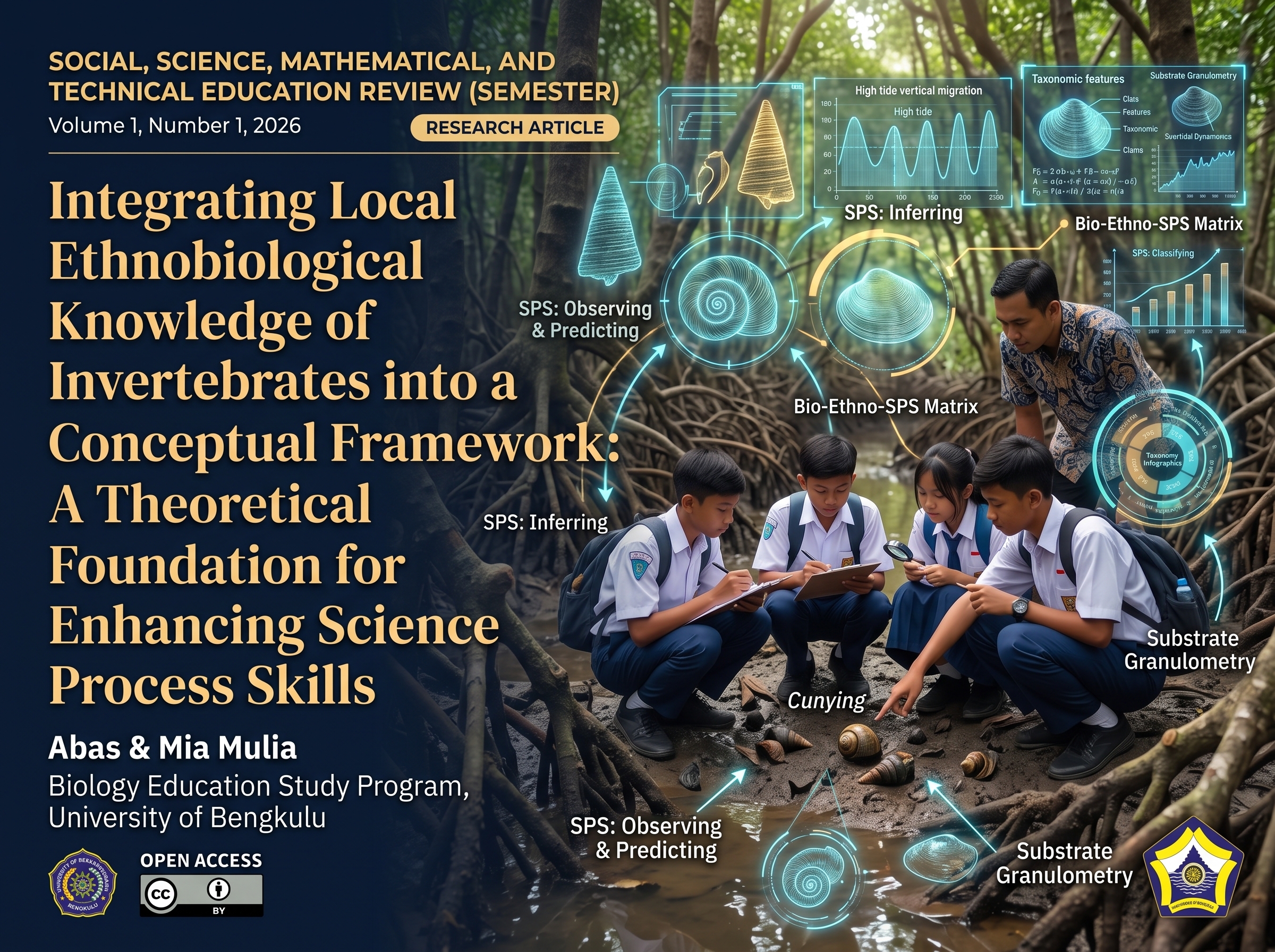
Integrating Local Ethnobiological Knowledge of Invertebrates into a Conceptual Framework: A Theoretical Foundation for Enhancing Science Process Skills
DOI:
https://doi.org/10.68964/fym59w37Keywords:
Ethnobiology, Invertebrates, Science Process Skills (SPS), Conceptual Model, Culturally Responsive Teaching;Abstract
The disconnect between formal science education and students' socio-cultural realities often leads to scientific alienation in developing regions. While ethnobiology offers a bridge to contextualize learning, existing literature is heavily skewed towards ethnobotany, neglecting the pedagogical potential of local fauna. This study aims to develop a novel conceptual model integrating the ethnobiology of local invertebrates from Bengkulu, Indonesia, into the junior high school science curriculum. Using a qualitative-theoretical synthesis approach, we reconstructed indigenous knowledge regarding three key taxa: Geloina erosa (Lokan), Telescopium telescopium (Cunying), and Meretrix sp. (Remis). The study mapped this "village science," such as the use of Lokan as a river quality bio-indicator and the tidal migration behavior of Cunying, onto specific Science Process Skills (SPS) indicators. The result is the "Bio-Ethno-SPS" conceptual framework. This model provides a structured pedagogical pathway for teachers to transform local wisdom into rigorous scientific inquiry, fostering skills such as observation, inference, and prediction. We conclude that Bengkulu invertebrate ethnobiology is not merely cultural heritage but a sophisticated epistemological resource for Culturally Responsive Teaching (CRT).
Downloads
References
Aikenhead, G. S. (2001). Integrating western and aboriginal sciences: Cross-cultural science teaching. Research in Science Education, 31(3), 337–355. https://doi.org/10.1023/A:1013151709605
Albuquerque, U. P., & Hurrell, J. A. (2010). Ethnobotany: One concept and many interpretations.
Natureza & Conservação, 8(1), 3–17. https://doi.org/10.4322/natcon.00801001
Alves, R. R. N., & Albuquerque, U. P. (2018). Ethnozoology: Animals in Our Lives. Academic Press. https://doi.org/10.1016/C2016-0-03732-4
Alves, R. R. N., et al. (2021). The role of invertebrates in ethnozoological research: A global overview. Journal of Ethnobiology and Ethnomedicine, 17(1), 45–58. https://doi.org/10.1186/s13002-021-00472-x
Ardan, A. S., et al. (2023). Developing ethnoscience-based conceptual models for improving scientific argumentation. International Journal of Science Education, 45(8), 612–630. https://doi.org/10.1080/09500693.2023.2198745
Berkes, F. (2017). Sacred Ecology. Routledge. https://doi.org/10.4324/9781315114644
Fahmi, F., et al. (2019). The development of science learning materials based on local wisdom to improve students' Science Process Skills. Journal of Physics: Conference Series, 1157(2), 022026. https://doi.org/10.1088/1742-6596/1157/2/022026
Fahmi, F., et al. (2021). Impact of local wisdom-based science learning on junior high school students' science process skills: A meta-analysis. Jurnal Pendidikan IPA Indonesia, 10(1), 112–122. https://doi.org/10.15294/jpii.v10i1.27891
Gay, G. (2018). Culturally Responsive Teaching: Theory, Research, and Practice (3rd ed.). Teachers College Press.
Gormally, C., et al. (2022). Assessing the development of science process skills in authentic inquiry environments. Journal of Research in Science Teaching, 59(4), 550–578. https://doi.org/10.1002/tea.21734
Hadzigeorgiou, Y. (2015). A review of science education research on the role of narrative. Studies in Science Education, 51(1), 41–75. https://doi.org/10.1080/03057267.2014.984447
Hernandez, M., et al. (2022). Connecting culture and biology: The impact of local fauna on student engagement. Journal of Biological Education, 56(2), 201–215. https://doi.org/10.1080/00219266.2021.1905872
Hunn, E. (2007). Ethnobiology in four phases. Journal of Ethnobiology, 27(1), 1–10. https://doi.org/10.2993/0278-0771(2007)27[1:EIFP]2.0.CO;2
Kimmerer, W. R. (2002). Weaving traditional ecological knowledge into biological education. BioScience, 52(5), 432–438. https://doi.org/10.1641/0006-3568(2002)052[0432:WTEKIB]2.0.CO;2
Ladson-Billings, G. (1995). Toward a theory of culturally relevant pedagogy. American Educational Research Journal, 32(3), 465–491. https://doi.org/10.3102/00028312032003465
Lee, H. S., & Brown, M. (2025). Pedagogical advantages of invertebrate biology in secondary education. Trends in Ecology & Evolution, 40(1), 12–25. https://doi.org/10.1016/j.tree.2024.11.005
NGSS Lead States. (2013). Next Generation Science Standards: For States, By States. National Academies Press. https://doi.org/10.17226/18290
Parmin, P., et al. (2017). Potential of local wisdom of Central Java North Coast in developing science learning models. Jurnal Pendidikan IPA Indonesia, 6(1), 27–35. https://doi.org/10.15294/jpii.v6i1.8154
Rahmawati, Y., & Taylor, P. C. (2018). The role of transformative learning in an ethno-chemistry curriculum. Journal of Science Education and Technology, 27(1), 53–71. https://doi.org/10.1007/s10956-017-9707-x
Rezba, R. J., et al. (2007). Learning and Assessing Science Process Skills. Kendall Hunt Publishing.
Sjöström, J., & Eilks, I. (2024). The role of indigenous knowledge in socio-scientific issues-based science education. Studies in Science Education, 60(1), 89–114. https://doi.org/10.1080/03057267.2023.2245671
Snyder, H. (2019). Literature review as a research methodology: An overview and guidelines.
Journal of Business Research, 104, 333–339. https://doi.org/10.1016/j.jbusres.2019.07.039
Suastra, I. W., et al. (2017). Developing characters based on local wisdom of Bali in science learning in junior high school. Jurnal Pendidikan IPA Indonesia, 6(2), 303–312. https://doi.org/10.15294/jpii.v6i2.10681
Yuliana, I., et al. (2021). Ethnoscience-based science learning in Indonesia: A systematic reviews and bibliometric analysis. Journal of Physics: Conference Series, 1842(1), 012077. https://doi.org/10.1088/1742-6596/1842/1/012077
Zidny, R., Sjöström, J., & Eilks, I. (2020). A multi-perspective reflection on integrating indigenous knowledge into world-wide science education. Science & Education, 29(1), 145–187. https://doi.org/10.1007/s11191-020-00101-1
Zidny, R., & Eilks, I. (2022). Integrating perspectives from indigenous knowledge and Western science in secondary and higher education to foster sustainability education. Education Sciences, 12(4), 249. https://doi.org/10.3390/educsci12040249