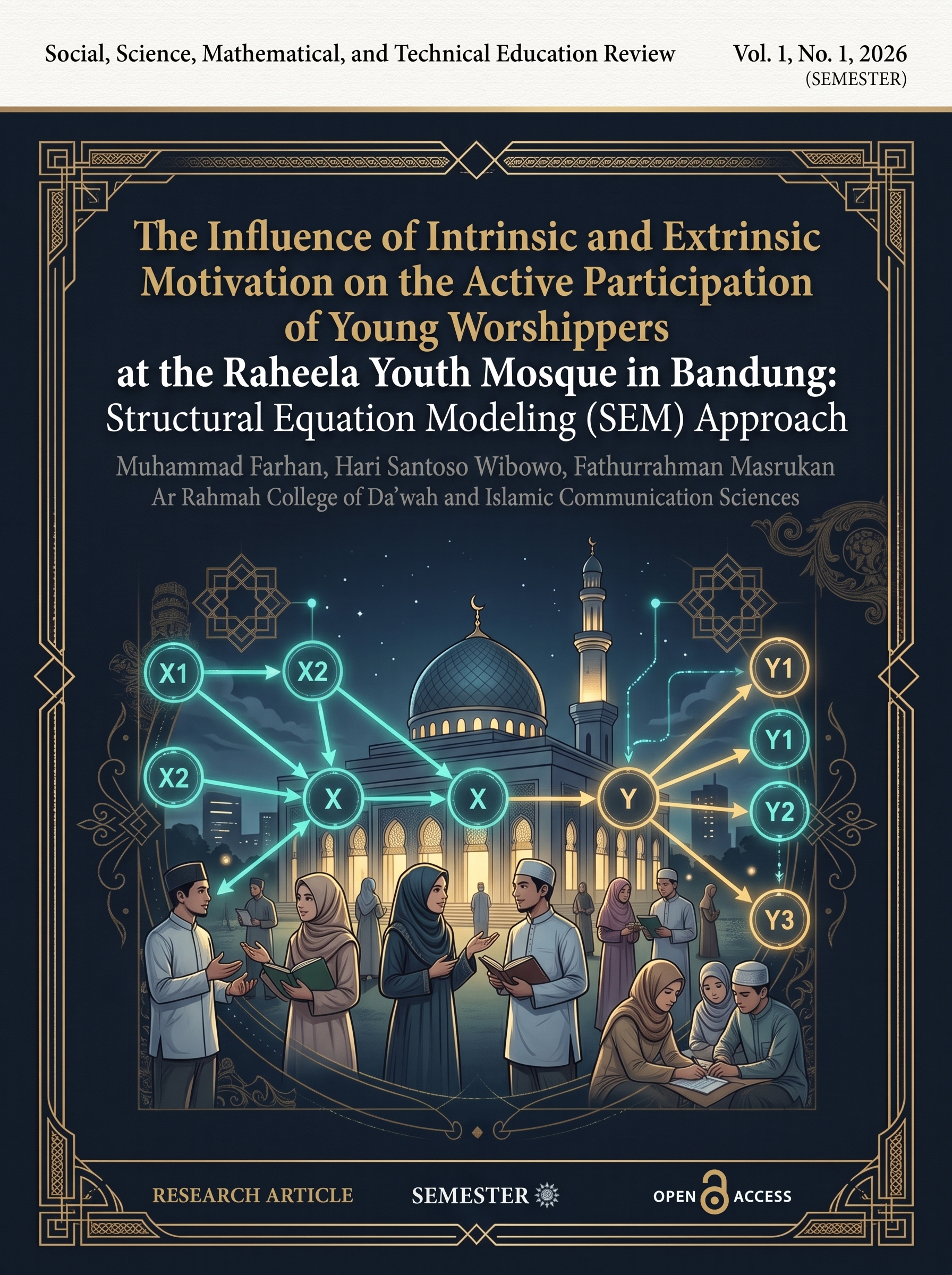
The Influence of Intrinsic and Extrinsic Motivation on the Active Participation of Young Worshippers at the Raheela Youth Mosque in Bandung: Structural Equation Modeling (SEM) Approach
DOI:
https://doi.org/10.68964/s8bfrj81Keywords:
Ethnobiology;, Invertebrates;, Science Process Skills (SPS);, Conceptual Model;, Culturally Responsive Teaching;, BengkuluAbstract
The active participation of youth in mosque activities in urban environments faces the challenges of lifestyle complexity and individualism. This study aims to analyze the influence of intrinsic motivation (theological imperative) and extrinsic motivation (environmental catalyst) on the active participation of young pilgrims in non-compulsory activities at the Raheela Youth Mosque, Bandung. Using a quantitative approach with the Structural Equation Modeling (SEM) method through the LISREL 8.80 software, data were collected from 150 respondents using validated instruments. The results showed that motivation had a positive and significant effect on active participation (β = 0.638, t = 6.545 > 1.96). Extrinsic motivation (X2) was found to be a more dominant driver (0.789) than intrinsic motivation (X1). The motivation variable was able to explain 40.7% of the variance of the active participation of pilgrims. These findings imply the importance of the professionalism of mosque management and the creation of a conducive social ecosystem to increase the involvement of the young generation in urban areas.
Downloads
References
Ammerman, N. T. (2020). Studying lived religion: Contexts and practices. New York University Press.
Arshad, M. (2022). The impact of professionalism in mosque management on youth satisfaction.
Journal of Islamic Management, 4(1), 12-28.
Casidy, R. (2014). Religiosity and church loyalty: A study of religious marketing. Journal of Retailing and Consumer Services, 21(2), 195-207.
Chen, L. (2022). Social capital and religious volunteering: A cross-cultural analysis. Wills, 33(1), 88-102.
Everitt, J. B., & Smith, C. (2020). The geography of religious engagement: Urban environments and youth participation. Journal for the Scientific Study of Religion, 59(2), 231-248. https://doi.org/10.1111/jssr.12651
Hair, J. F., Black, W. C., Babin, B. J., & Anderson, R. E. (2019). Multivariate data analysis (8th ed.). Cengage Learning.
Hassan, A., & Sani, M. (2022). Islamic marketing and mosque loyalty: The role of social services.
Journal of Islamic Marketing, 13(4), 882-901.
Hefner, R. W. (2018). Routledge handbook of contemporary Indonesia. Routledge.
Jöreskog, K. G., & Sörbom, D. (2006). LISREL 8.80: Structural equation modeling with the SIMPLIS command language. Scientific Software International.
Kamaruddin, R. (2020). The role of theology and social catalyst in youth motivation. Journal of Religion and Health, 59(5), 2415-2430.
Kline, R. B. (2023). Principles and practice of structural equation modeling. Guilford Publications.
Mubarak, Z., & Arshad, M. (2023). Digital transformation of religious organizations: A case study of urban mosques. International Journal of Religious Tourism and Pilgrimage, 11(1), 45-60.
Putnam, R. D. (2000). Bowling alone: The collapse and revival of American community. Simon & Schuster.
Riaz, M. (2020). Urban mosques as third spaces: Redefining community in individualistic societies.
Contemporary Islam, 14(3), 311-329.
Saroglou, V. (2011). Believing, bonding, behaving, and belonging: The big four religious dimensions and cultural variation. Journal of Cross-Cultural Psychology, 42(8), 1320-1340.
Smith, R. (2019). Extrinsic vs intrinsic religiosity in the 21st century: A meta-analysis. Archive for the Psychology of Religion, 41(2), 101-118.
Stark, R., & Finke, R. (2000). Acts of faith: Explaining the human side of religion. University of California Press.
Taylor, P. J., & Perry, D. C. (2005). Diffusion of Internet adoption: A study of the relationship between religiosity and the Internet. Religion, 35(2), 77-89.
Wuthnow, R. (2004). Saving America? Faith-based services and the future of civil society.
Princeton University Press.
Zulkifli, M., & Kamaruddin, R. (2021). Determinants of active participation in non-mandatory religious activities among Muslim youth. Journal of Muslim Minority Affairs, 41(2), 156-172.